Timeless Words for an Enduring Journey
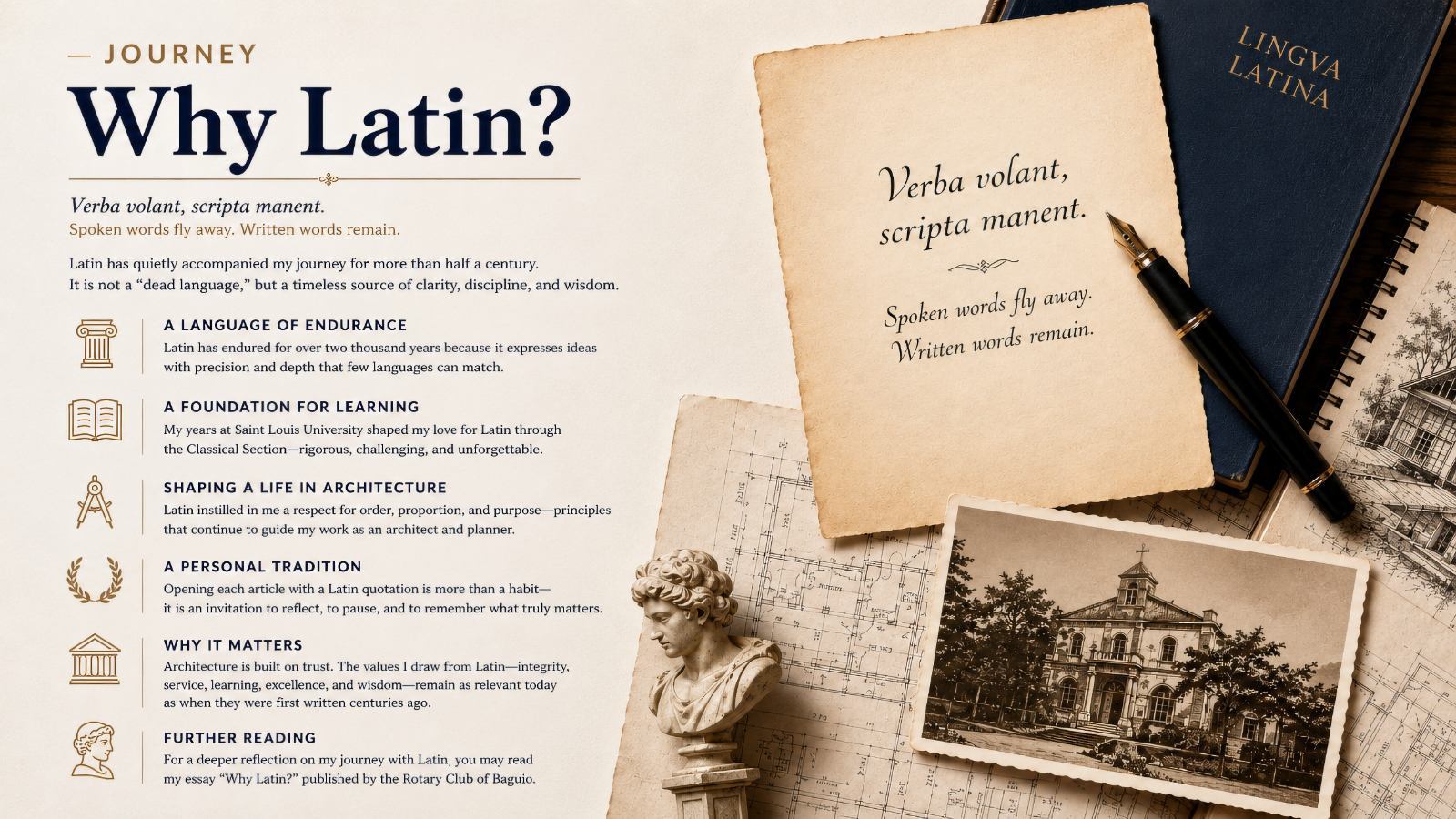
"Verba volant, scripta manent."
Spoken words fly away. Written words remain.
Throughout this website, you will notice that many of its major pages begin with a short quotation in Latin. Some visitors have asked why.
After all, Latin is often described as a "dead language." Why not simply use English?
For me, Latin has never been dead. It has quietly accompanied my journey for more than half a century.
Where It All Began
My relationship with Latin began during my years at Saint Louis University Boys' High School in Baguio City.
I was admitted to the school's Classical Section, an academically rigorous program reserved for its highest-performing students. Unlike today's curricula, ours included four full years of Latin, exposing us to the language, grammar, philosophy, and enduring wisdom of classical literature.
Our graduating class of 1969 became known as "The Last of the Classicals." After our graduation, the Classical Section was replaced by the Science Section, bringing an end to a long academic tradition at SLU Boys' High.
Although I never imagined then that I would spend my professional life as an architect, those years cultivated an appreciation for precision of language, disciplined thinking, and timeless ideas that has remained with me ever since.
More Than Beautiful Words
The Latin quotations featured throughout this website were not chosen because they sound impressive.
Each one was carefully selected because it reflects the central message of the page where it appears.
Some speak of integrity.
Others remind us of perseverance, service, wisdom, responsibility, or lifelong learning.
Together, they quietly express the values that have shaped both my professional practice and personal journey over the past five decades.
A Lifelong Student
Returning to graduate school more than twenty years after earning my Bachelor of Science in Architecture reinforced a lesson I first encountered in those Latin classrooms—that education is a lifelong pursuit.
Professional recognition, experience, and success are meaningful, but they should never become reasons to stop learning.
That conviction led me to earn a Diploma in Urban and Regional Planning from the University of the Philippines, and later a Master of Arts in Environmental and Habitat Planning from Saint Louis University, graduating Magna Cum Laude.
Latin reminds me that wisdom is not measured merely by knowledge acquired, but by the willingness to keep learning throughout life.
The Wisdom Behind Architecture
Architecture is often viewed simply as the design of buildings.
I have always believed it is something more.
Good architecture begins with thoughtful listening, careful observation, disciplined thinking, and responsible decision-making. These qualities have guided architects, builders, philosophers, and civic leaders for centuries.
The quotations found throughout this website serve as quiet reminders that while technology constantly changes, the principles of good design, ethical practice, and service to others remain remarkably constant.
A Personal Tradition
Over the years, opening an article with a Latin quotation became something of a personal tradition.
Whenever I write about architecture, environmental planning, leadership, or public service, I enjoy beginning with a thought that has already stood the test of time.
Each quotation invites the reader to pause for a moment before continuing.
Sometimes a single sentence, refined over centuries, can express an idea more elegantly than several paragraphs.
Why It Matters
Architecture is ultimately built on trust.
Clients entrust architects with significant investments, communities, and aspirations.
Technical knowledge is essential, but character is equally important.
The quotations throughout this website reflect the principles that continue to guide my work:
- Integrity before convenience
- Service before recognition
- Learning without end
- Excellence through discipline
- Wisdom gained through experience
These ideals remain as relevant today as when they were first expressed centuries ago.
Further Reading
My interest in Latin extends beyond this website.
Several years ago, I wrote a personal reflection entitled "Why Latin?", published on the website of the Rotary Club of Baguio. That essay explores my lifelong appreciation for Latin and why its timeless expressions continue to inspire both my professional work and personal reflections.
You may wish to read the original article there. Why Latin?