Three Days That Changed My Life
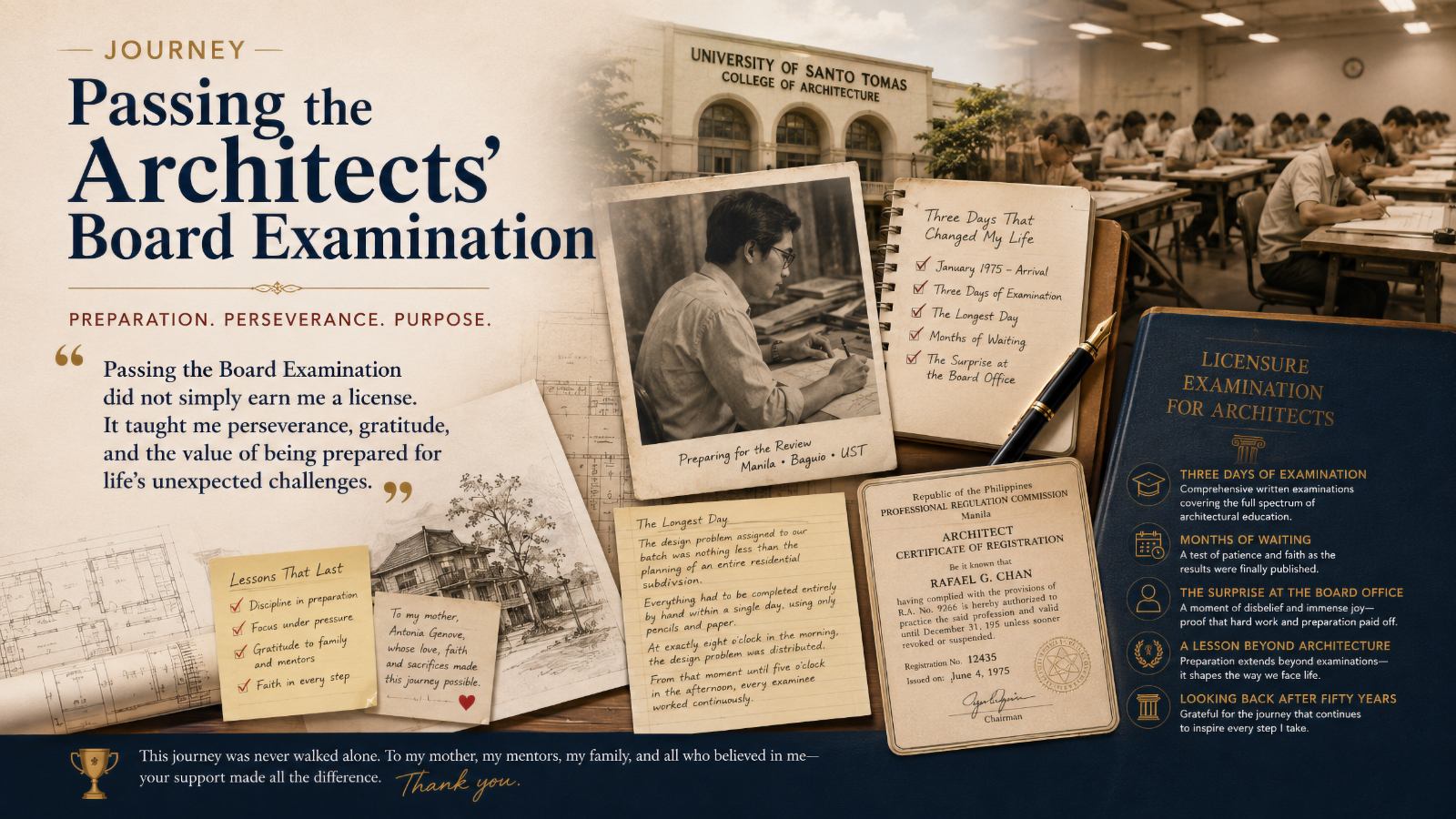
"Every architect remembers the day he became an architect. I also remember everyone who helped me get there."
Earning my Bachelor of Science in Architecture from Saint Louis University in 1973 was only the beginning. Like every aspiring architect in the Philippines, I still had to pass the national Architects' Licensure Examination before I could legally practice the profession.
Looking back today, that journey remains one of the defining experiences of my life—not simply because of the examination itself, but because it reminded me how much I depended on the love and support of my family.
My Mother Made It Possible
Several months before the January 1975 Board Examination, my mother, Antonia Genove, personally accompanied me to the University of Santo Tomas College of Architecture to enroll in its intensive one-month review course.
I still remember meeting the Dean of Architecture, Architect Cesar Concio Jr., who warmly accommodated us during the enrollment process.
While I concentrated on preparing for the review, my mother quietly attended to everything else.
Using her friends and contacts in Baguio and Manila, she found me a comfortable place to stay near UST. The family that welcomed me into their home—the Lee family—provided me with room and board during the review period.
Looking back now, I realize how much I depended on my mother during those days. Like many young graduates, I was focused on the examination itself, while she quietly made sure I had every opportunity to succeed.
Learning to Live in Manila
Living in Manila for a month was an experience in itself.
Coming from Baguio City, I quickly learned what it meant to experience heavy monsoon rains in the capital. There were days when jeepneys simply disappeared from the streets because of flooding, leaving us no choice but to walk considerable distances back to our lodgings.
They were small inconveniences, but they became part of an unforgettable chapter of my life.
Three Days of Examination
January 1975 finally arrived.
Fortunately, the Architects' Licensure Examination was also held at the University of Santo Tomas, where I had completed my review.
Unlike today, the examination lasted three separate days—Monday, Wednesday, and Friday.
The first two days consisted of comprehensive written examinations covering the broad spectrum of architectural education, including architectural history, design theory, structural design, building laws, and mechanical-electrical systems.
Then came Friday.
Every candidate arrived carrying a drafting board, T-square, triangles, pencils, erasers. Tracing paper was provided by the watchers, who can give you as many as all you need.
At exactly eight o'clock in the morning, the design problem was distributed.
From that moment until five o'clock in the afternoon, every examinee worked continuously to complete an entire architectural design project. Lunch was usually forgotten by most, despite being allowed to bring personal sustenance for the day.
The Longest Day
The design problem assigned to our batch was nothing less than the planning of an entire residential subdivision.
The required submissions included:
- Overall subdivision layout, including road networks and other amenities
- Four standard residential floor plans:
- 2 floor plan designs- two-bedroom residences
- 2 floor plan designs- three-bedroom residences
- Building elevations- as appropriate
- Building sections- as appropriate
- Fully rendered Exterior Perspective illustrating the whole proposed subdivision development
Today, simply listing those requirements leaves me breathless. An easy tip: complete all the drawings, in order to have a chance to pass the exam. Those unable to complete all the required drawings, are guaranteed to fail.
Everything had to be completed entirely by hand within a single day, using only pencils and paper. Using ink was not allowed.
Only drawing instruments, tracing paper, and years of manual architectural drafting training.
Months of Waiting
After the examinations ended, another challenge began.
Waiting.
The Board of Architecture, then composed of three respected architect examiners, personally evaluated every written paper and every design solution submitted by candidates from across the country.
The process naturally took several months.
As was customary, the results were finally published around June in the newspapers, particularly The Manila Times.
Like thousands of hopeful examinees, I eagerly searched for my name.
It was nowhere to be found.
The Surprise Waiting at the Board Office
Disappointed and confused, I decided to visit the Board of Architecture office personally.
To my immense relief, I learned that I had actually passed the examination.
My name, however, was among those withheld because my Chinese-sounding surname raised questions regarding my citizenship.
I respectfully explained that I had completed the required ROTC program during college years, believing this clearly affirmed my decision to choose Filipino citizenship.
The examiner, however, did not agree with my initial explanation; required other documentary proof.
Fortunately, I happened to have my Voter's Identification Card with me. To this day, i still ask myself why i had it with me on that fateful day.
After examining it, he smiled.
That was all the proof he needed.
Right there in the Board Office, I was administered my oath as a newly licensed Architect.
It remains one of the happiest moments of my life.
A Lesson Beyond Architecture
Looking back, I often think about how a seemingly ordinary decision—registering as a voter years earlier—became the one document that resolved an unexpected obstacle at the most important moment of my professional life.
Life has a remarkable way of reminding us that small decisions often carry consequences we never foresee.
That experience taught me that preparation extends beyond examinations.
It includes the everyday choices we make, often without realizing how important they may someday become.
Looking Back After Fifty Years
Much has changed since I took the Architects' Board Examination.
Today's licensure examination has evolved considerably in its format and evaluation methods. Modern testing places greater emphasis on objective assessment through multiple-choice questions, while the full-day architectural design examination that challenged our generation is no longer part of the process.
Every generation has its own standards and methods of evaluation, and each reflects the needs of its time.
Still, speaking only as someone who experienced the earlier format, I remain grateful that our examination required us to demonstrate not only what we knew, but also what we could actually design under pressure.
That demanding experience became one of the foundations of my professional confidence throughout more than five decades of architectural practice.
And every time I sign my name as an architect, I still remember my mother, the Lee family, my review mentors at UST, and the unexpected visit to the Board Office that finally made it official.
Only then could I truly call myself:
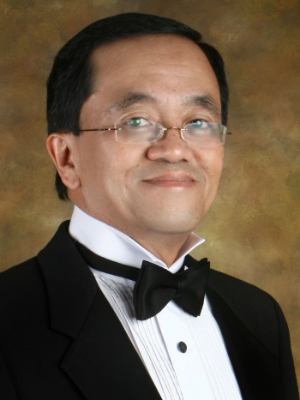
Architect Rafael G. Chan.