Why Integrated Building Information Modeling Changed Architecture
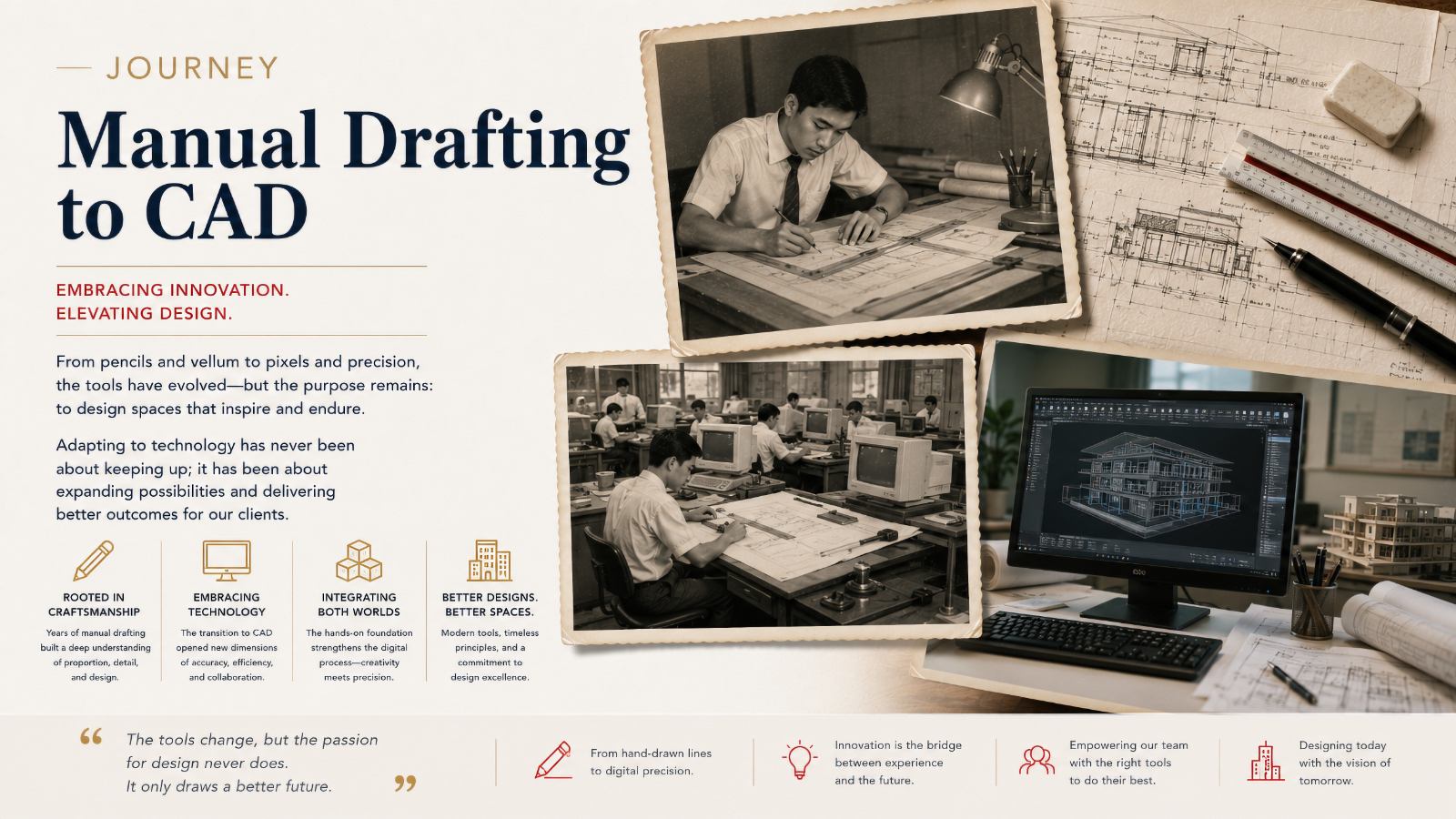
The evolution from manual drafting to Computer-Aided Design was only the beginning.
The next revolution proved even more profound. It fundamentally changed not only how drawings were produced, but how buildings themselves were conceived, coordinated, analyzed, and ultimately constructed.
For RG Chan & Associates, embracing Building Information Modeling (BIM) represented another major step in our continuing pursuit of better architecture.
Expanding an Architectural Practice Through Computer-Aided Design
After successfully transitioning from manual drafting to CAD, our office continued investing heavily in digital production.
Our production department eventually grew to eight fully equipped CAD workstations, each operated by a trained CAD technician. Rather than relying on outside instruction, every operator was developed in-house using office manuals that evolved through years of practical experience.
There is truly no substitute for what I often call the "University of Hard Knocks."
Every lesson learned through actual project production became another improvement to our office standards and procedures.
As CAD matured, sophisticated rendering software also began appearing. Programs such as 3D Studio, Lumion, and similar visualization tools enabled architects to produce increasingly realistic presentations that transformed how clients experienced proposed buildings before construction even began.
By the late 1990s, Computer-Aided Design had become the accepted standard, effectively bringing the era of manual drafting to a close.
Discovering the Early Foundations of Building Information Modeling
While CAD continued improving, my own reading and research suggested that something even more revolutionary was beginning to emerge.
During the late 1990s—well before YouTube tutorials and online training became available—Autodesk introduced Architectural Desktop, an application built on top of AutoCAD.
The concept was remarkable.
Instead of merely drawing lines in plan, architects could begin constructing an intelligent digital building whose plans, elevations, and sections were interconnected.
Although groundbreaking, the software proved difficult to master. It was powerful but cumbersome, and many architects struggled to fully appreciate its potential.
Nevertheless, it offered an early glimpse into what architecture would eventually become.
Learning Revit During the Early Years of BIM
The true turning point came in 2002, when Autodesk acquired Revit, originally developed by Revit Technology Corporation, formerly Charles River Software.
Even during its infancy, I immediately began experimenting with the software.
Learning Revit was unlike learning another CAD program.
It required adopting an entirely different way of thinking.
The transition was challenging. There were few local users, no organized training programs, and very little instructional material available in the Philippines. My earliest references consisted of printed books ordered from the United States through Amazon, often taking nearly a month to arrive in Baguio.
Each chapter became another lesson in understanding what would eventually become the future of architectural production.
Why Building Information Modeling Makes a Difference
Over time, Autodesk discontinued Architectural Desktop and made Revit its flagship BIM platform—a decision that, in hindsight, proved remarkably farsighted.
Although ArchiCAD had introduced Building Information Modeling earlier, Revit gradually became the industry's dominant BIM platform worldwide.
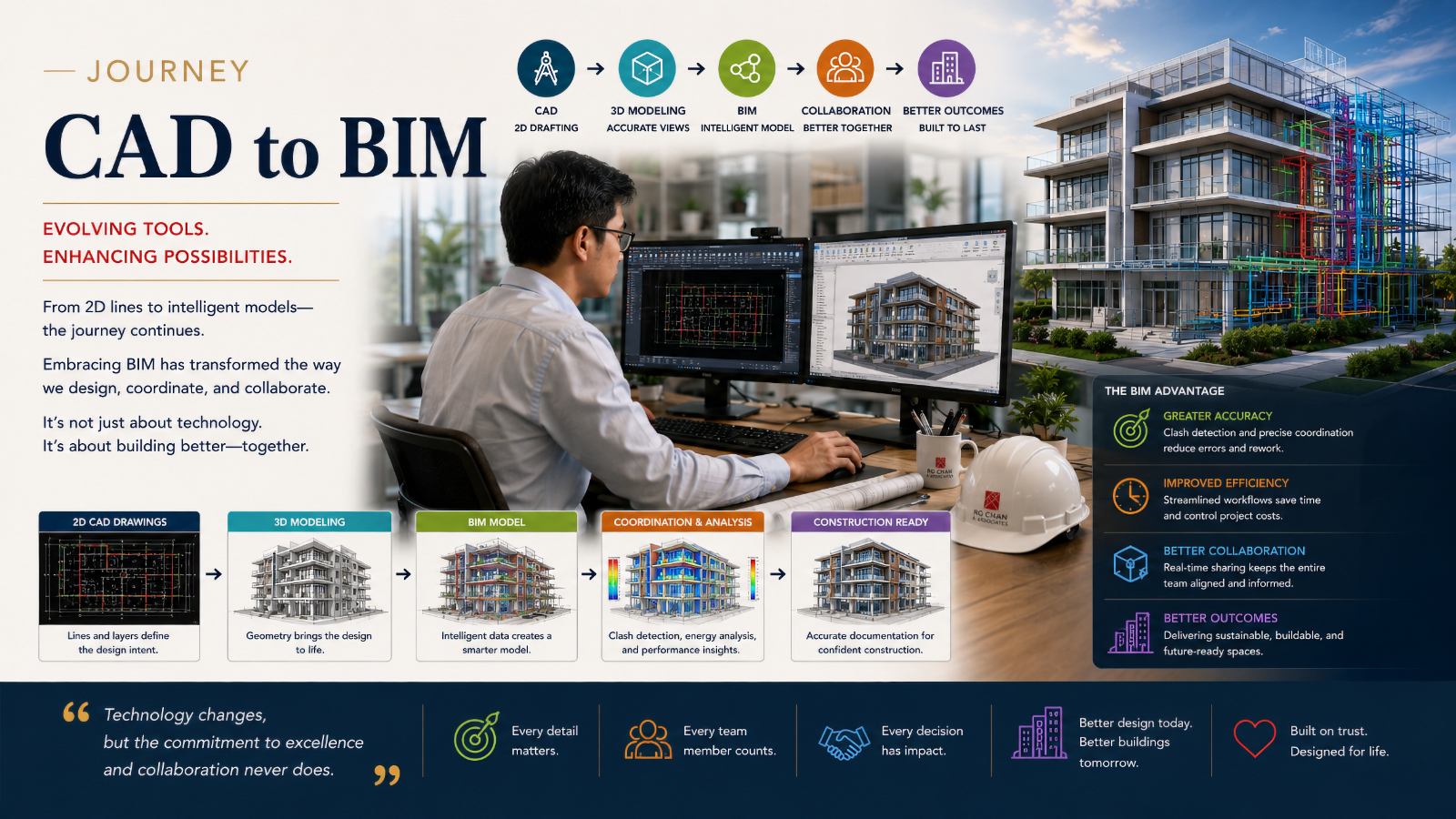
The difference between CAD and BIM is far greater than many people realize.
Traditional CAD workflows typically involve preparing two-dimensional production drawings while separate software such as SketchUp, Lumion, Enscape, or 3ds Max is used independently to generate presentation models and rendered perspectives.
Building Information Modeling follows an entirely different philosophy.
At RG Chan & Associates, every wall, floor, roof, window, beam, column, and room exists as part of a single intelligent digital building model. Plans, elevations, sections, schedules, perspectives, and three-dimensional views are generated from the same coordinated database.
Every revision automatically updates the entire project, dramatically reducing inconsistencies while improving coordination among all disciplines.
It is a far more integrated and holistic approach to design.
Why BIM Represents the Future of Architectural Practice
Today, AutoCAD remains the production platform used by many architectural offices throughout the Philippines.
However, firms fully committed to Building Information Modeling enjoy significant advantages in coordination, visualization, documentation, and long-term project management.
The learning curve is admittedly steep.
Even today, only a handful of architectural firms in Baguio have fully embraced Revit as their primary production platform. Most continue relying on conventional CAD workflows because transitioning to BIM requires substantial investments in software, hardware, training, and office procedures.
Yet every technological transition throughout my career has reinforced the same lesson.
Those willing to embrace innovation early are often the ones best prepared for the future.
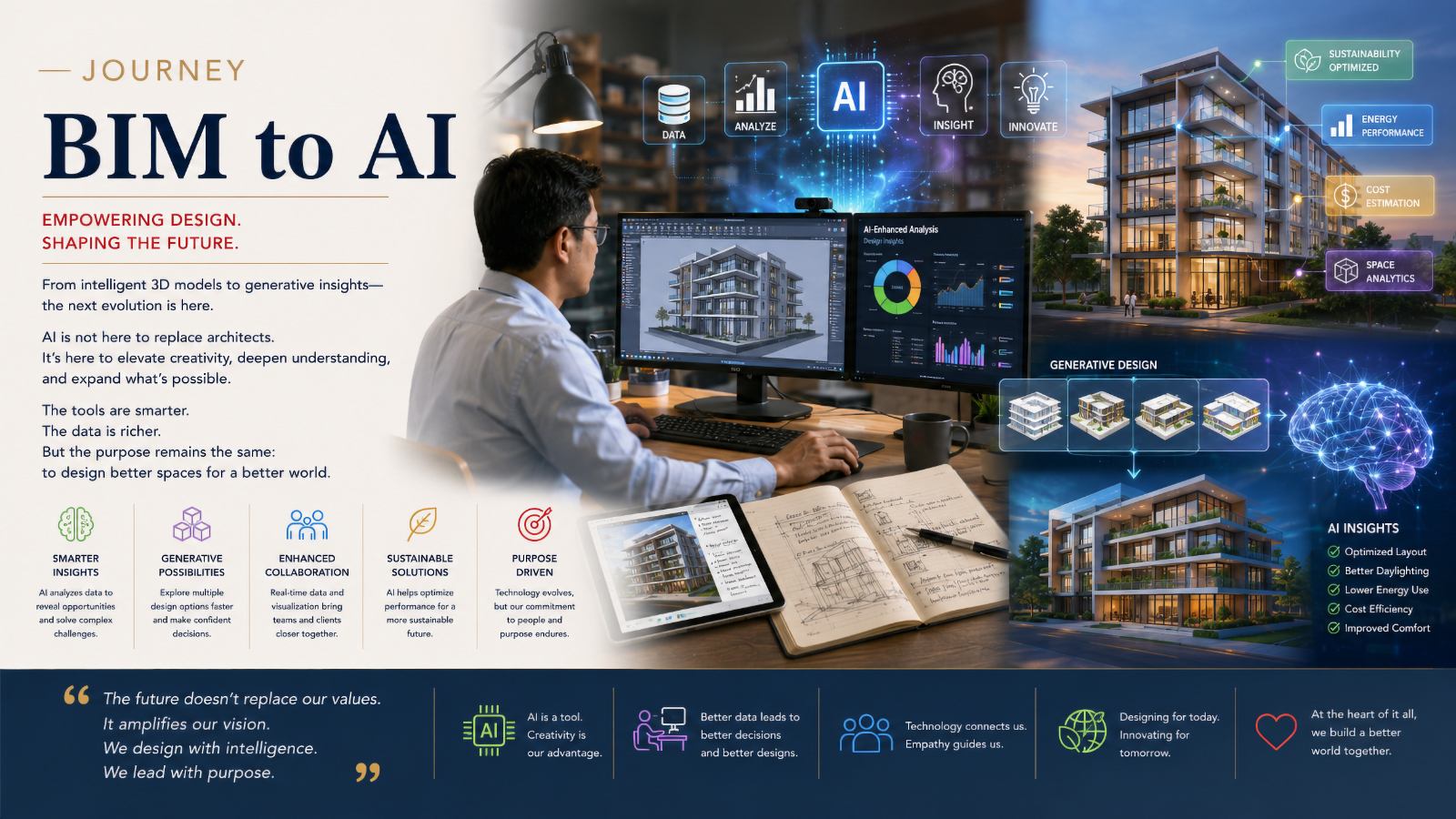
Looking back, I remain grateful that RG Chan & Associates chose to continue evolving—from pencils, to CAD, from CAD to BIM, and now toward the exciting possibilities of Artificial Intelligence.
Technology will continue changing.
Our commitment to learning must continue changing with it.