Tracing the Evolution from Building Information Modeling to Artificial Intelligence in Architecture
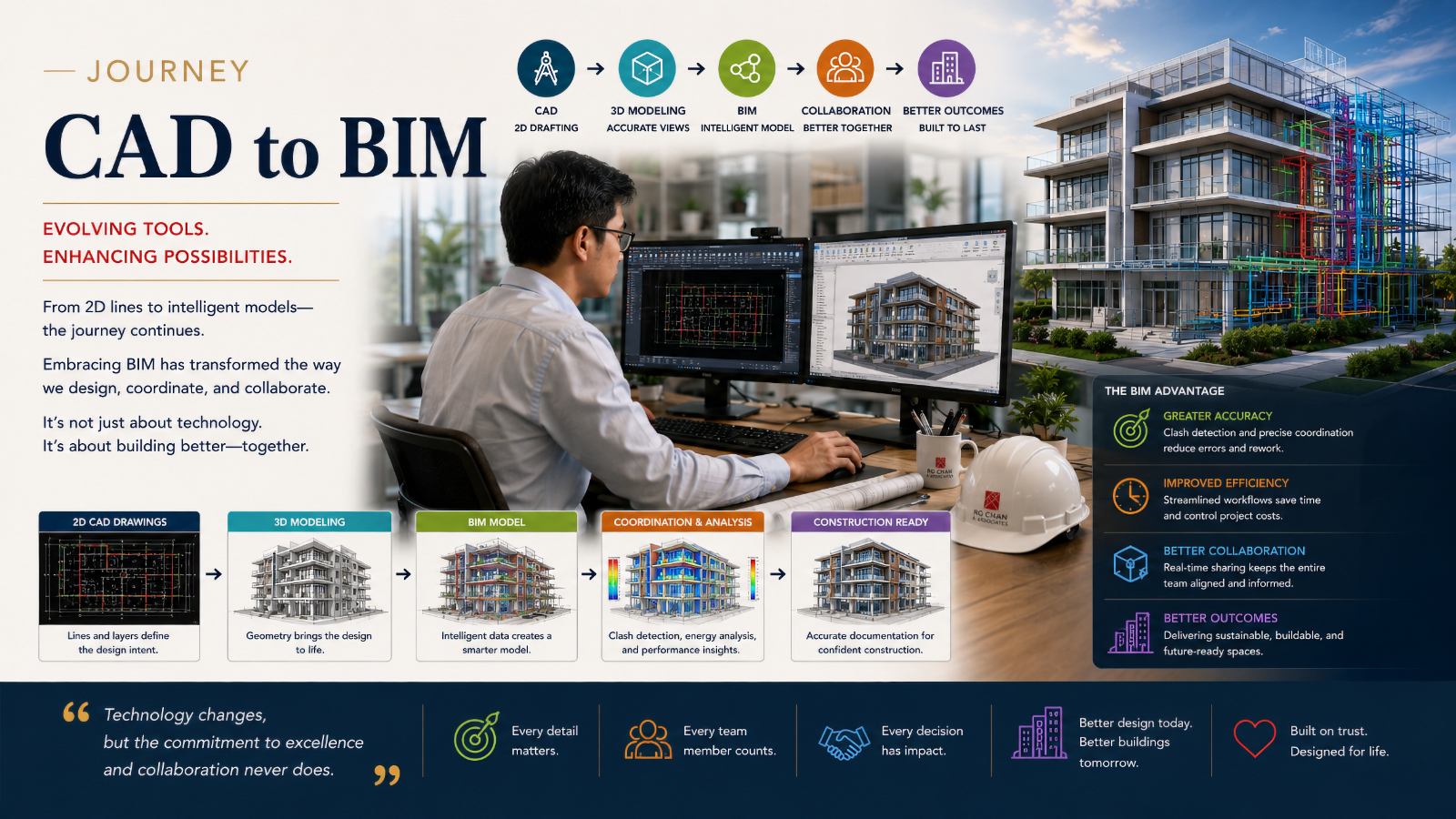
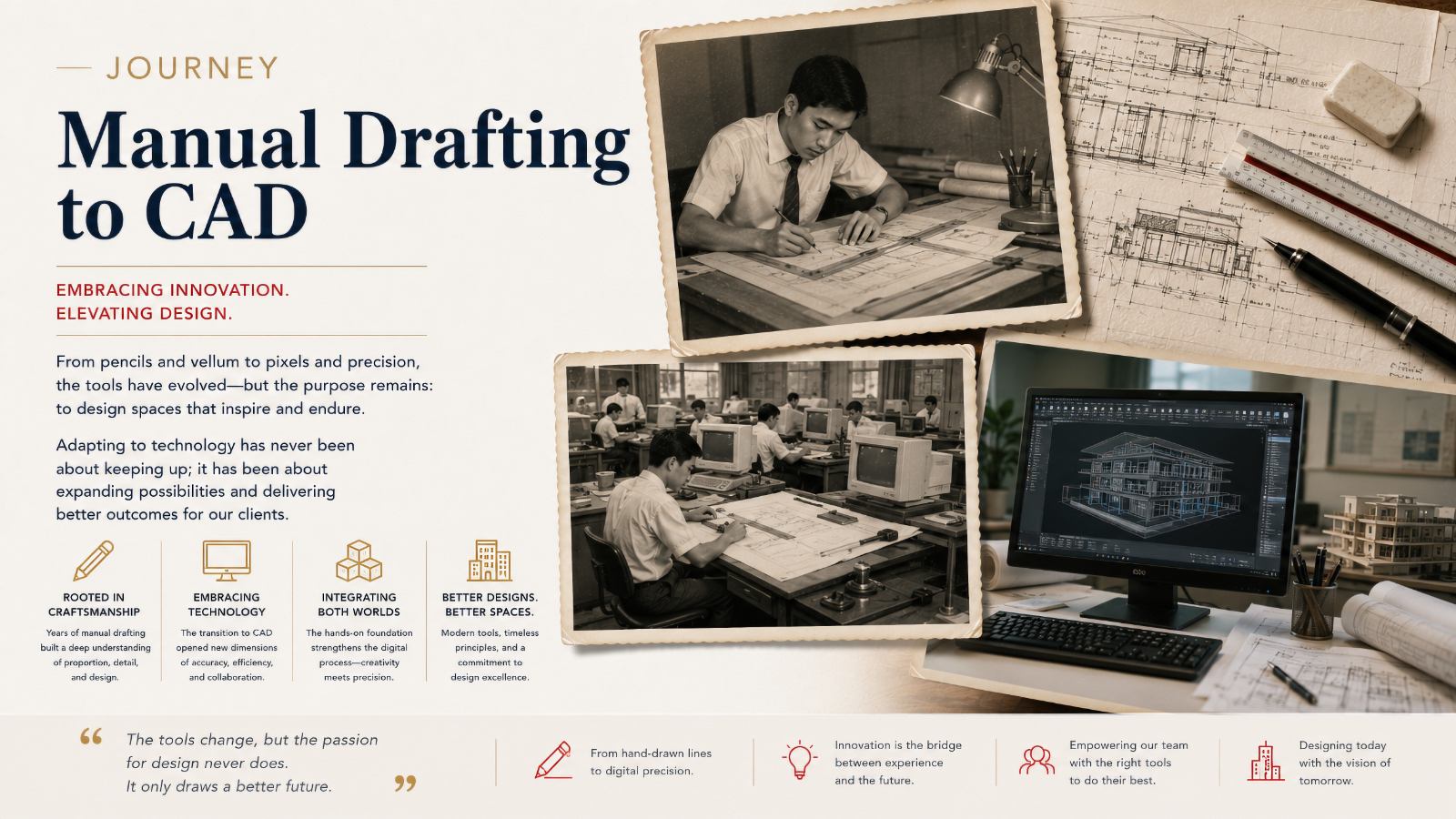
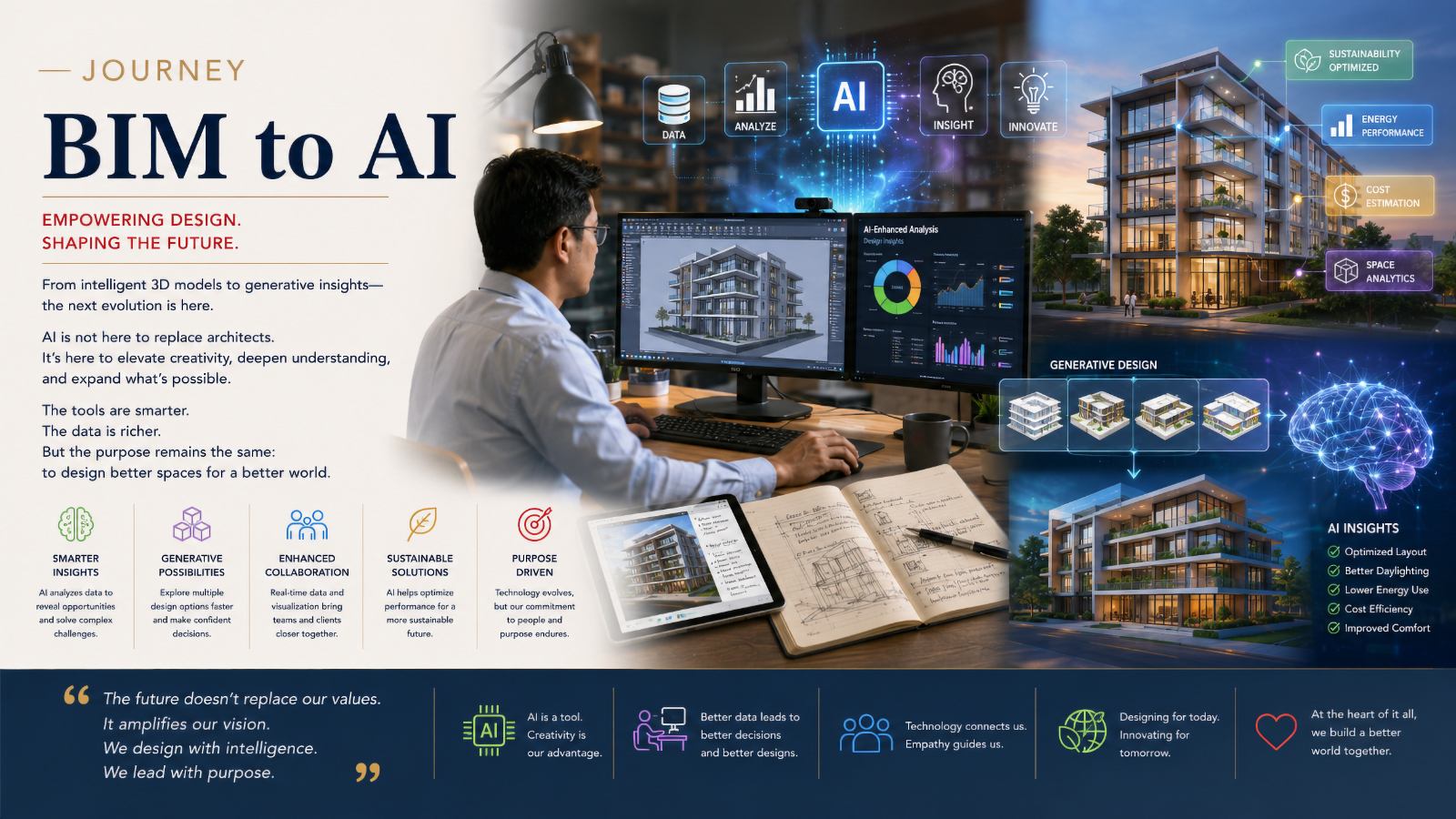
Artificial intelligence is the latest milestone in a technological journey that began decades ago. At RG Chan & Associates, our transition from manual drafting to CAD, and later from CAD to Building Information Modeling (BIM), naturally led us to explore the possibilities of AI. Rather than replacing architects, artificial intelligence is becoming another professional tool—one that enhances creativity, improves efficiency, and allows designers to spend more time solving problems that truly matter.
Having witnessed every major technological transition over the past five decades, I have learned that innovation is most valuable when it serves people. Every new technology should strengthen professional judgment, never replace it.
How Artificial Intelligence Is Transforming Architectural Practice
Artificial intelligence is rapidly transforming the way architects gather information, generate ideas, and communicate with clients. Tasks that once required hours of research or repetitive drafting can now be completed in minutes.
AI assists in preparing preliminary concepts, organizing project information, reviewing codes, improving written communication, producing marketing materials, and accelerating visualization. Used responsibly, these tools allow architects to devote more attention to design quality, coordination, and client service.
Like CAD and BIM before it, AI is becoming another important layer in the evolution of architectural practice.
Recently, while working on a Revit project, I was genuinely impressed by a new rendering add-in called D5 Render. It was the first AI-powered renderer I had encountered that could intelligently adjust rendering settings simply by following a text prompt and a reference image. From what I have learned, D5 Render is developed by a Chinese company and is rapidly giving many of the established rendering packages serious competition.
Why Professional Judgment Still Matters in the Age of AI
One important lesson has become increasingly clear: artificial intelligence is only as good as the person guiding it.
AI cannot visit a building site. It cannot fully understand local climate, cultural context, construction practices, or the unique priorities of each client. More importantly, it cannot replace decades of professional experience gained through designing, coordinating, supervising construction, and solving real-world problems.
Architecture remains a profession built on responsibility. Every design decision affects people's safety, comfort, investment, and quality of life. These responsibilities continue to belong to the architect—not to software.
From Learning CAD Alone to Learning AI Together
When I first adopted AutoCAD in the late 1980s, there were no online tutorials, discussion forums, or YouTube videos. Learning required patience, experimentation, and countless hours of trial and error.
Today's learning environment is remarkably different. Artificial intelligence provides immediate explanations, programming assistance, design references, writing support, and technical guidance that would once have required extensive research.
In many ways, AI has become a patient mentor available around the clock. Yet the willingness to keep learning remains exactly the same. Technology changes, but curiosity continues to be the architect's greatest advantage.
Integrating AI with Building Information Modeling
Because our office already embraced Building Information Modeling using Autodesk Revit, incorporating AI became a logical next step rather than a disruptive change.
Today, AI complements our BIM workflow by assisting with project research, preparing specifications, organizing documentation, improving website content, refining client presentations, generating illustrations, and supporting software development for architectural automation.
The combination of BIM's coordinated digital models and AI's analytical capabilities opens opportunities that were unimaginable only a few years ago. Information flows more efficiently, communication improves, and decisions can be made with greater confidence.
AI Is Expanding the Architect's Role Beyond Design
One unexpected benefit of artificial intelligence has been its ability to support areas beyond architectural production.
Our websites—RGCHAN.COM and RAFFYCHAN.COM—have been developed with significant AI assistance, allowing us to publish professional insights, document decades of experience, and communicate more effectively with clients around the world. AI has also become an invaluable partner in search engine optimization, technical writing, software development, image generation, and digital marketing.
Rather than limiting architectural practice to drawing buildings, AI has enabled us to share knowledge with a much wider audience.
Looking Ahead: Why Architects Should Embrace Artificial Intelligence
Having experienced manual drafting, CAD, BIM, and now AI, I remain convinced that every technological revolution rewards those willing to learn.
Some architects understandably hesitate to embrace new tools, just as many once resisted CAD or BIM. Yet history has consistently shown that technology eventually becomes part of everyday professional practice. The challenge is not deciding whether change will come—it is deciding whether we will be prepared for it.
Artificial intelligence will never replace thoughtful architects. Instead, it will increasingly distinguish those who combine experience, sound judgment, creativity, and integrity with the intelligent use of modern technology.
Looking back over more than fifty years in architecture, I consider AI not as the destination, but simply the next chapter in a lifelong commitment to learning. The drafting board gave way to CAD. CAD evolved into BIM. Today, BIM is being enhanced by artificial intelligence. Through every transformation, one principle has remained constant: technology serves the architect, but wisdom serves the client.