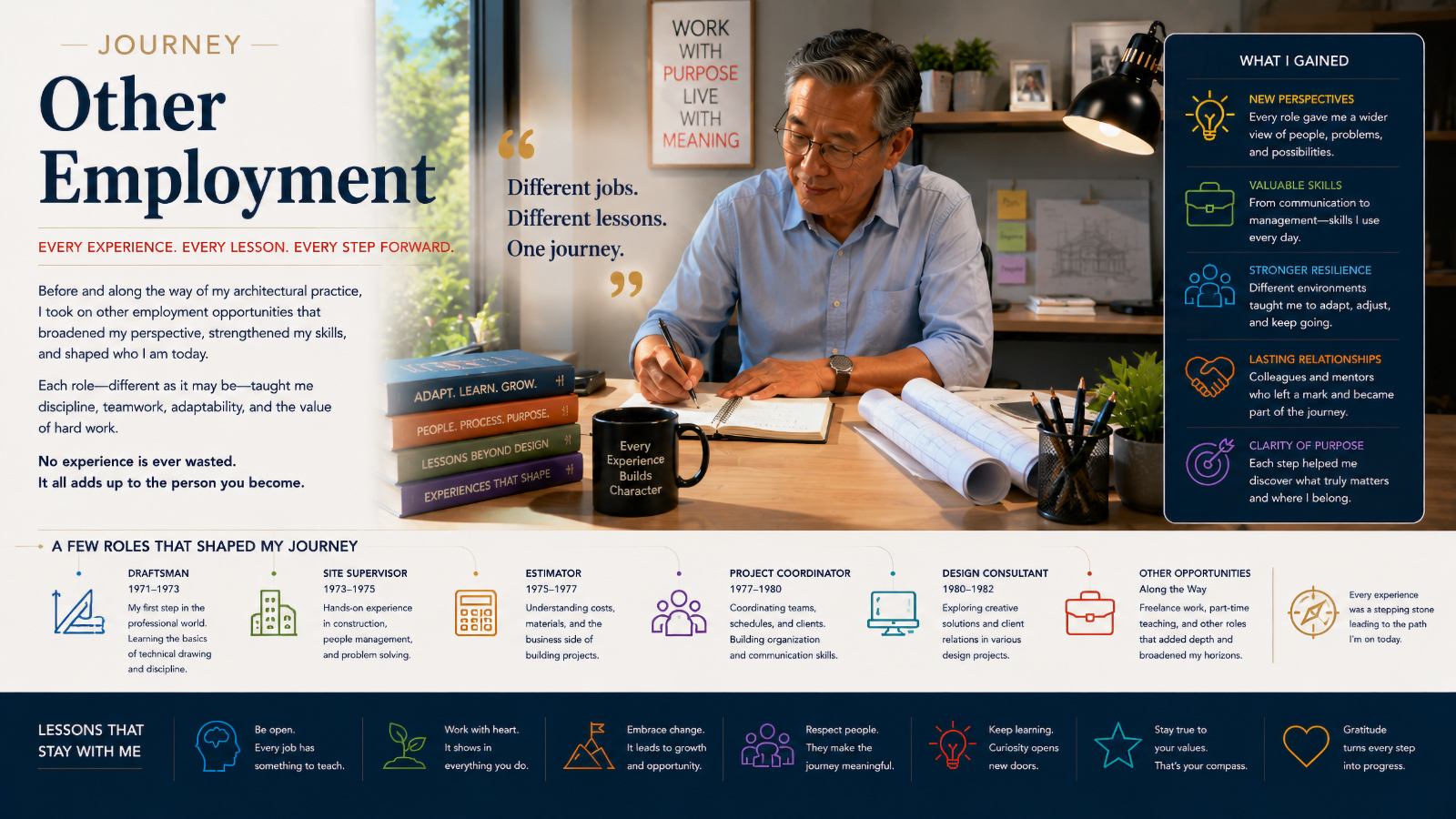
Before establishing RG Chan & Associates in 1982, I was fortunate to experience architecture from three very different professional environments. Each role expanded my understanding of the profession and contributed skills that would later become invaluable in private practice.
Looking back, I now realize these years were never simply different jobs. They were different classrooms, each teaching lessons that could never have been learned from books alone.
Lessons from Private Practice, Academe, and Government Service
From March 1975 to April 1976, I joined Federal Builders, then one of Manila's prominent construction companies owned by the Chua family.
My interview remains unforgettable. It took place at the company's head office along Ongpin Street, in the heart of Manila's Chinatown. I was accompanied by one of my late father's relatives, whom I understood to be a respected businessman in the area.
The interview itself consisted of only three IQ questions. Fortunately, I answered each one confidently. The senior Chua brother appeared impressed and hired me immediately.
My official designation was Supervising Project Architect.
By good fortune, Federal Builders had just begun constructing the Skyworld Condominiums along Session Road in Baguio City—an eleven-storey residential tower that allowed me to return home while gaining invaluable high-rise construction experience.
Learning High-Rise Construction from the Ground Up
Working on Skyworld exposed me to construction methods that few young architects of my generation had the opportunity to witness firsthand.
I observed the site fabrication of cast-in-place reinforced concrete piles and the pile-driving operation using a diesel hammer—technology that had never before been used in Baguio. I also witnessed the city's first use of a tower crane for systematic concrete placement and gained firsthand knowledge of post-tensioned beams and slabs using the Presscon System. Equally valuable was the opportunity to understand the coordination of mechanical and electrical systems required for a multi-storey building.
The project was designed by Manila-based Architect Thomas Diokno, with structural engineering provided by Felicisimo Cebedo, whose expertise contributed to introducing these advanced construction techniques to Baguio.
Sadly, Skyworld would later become one of the buildings that collapsed during the devastating 1990 Baguio earthquake. That tragedy remains an indelible part of the city's history. Yet my involvement in its construction provided invaluable lessons that significantly broadened my understanding of structural systems, construction technology, and the complexities of executing large-scale projects.
Teaching Future Architects at Baguio Colleges Foundation
From June 1976 until June 1978, I entered an entirely different environment by joining Baguio Colleges Foundation, now the University of the Cordilleras, as an Adjunct Instructor.
I taught a variety of architectural subjects, including Architectural Design, Building Laws and Regulations, Building Construction, and Theory of Design.
Teaching challenged me in unexpected ways.
Explaining architectural concepts to students required clarity, patience, and careful preparation. It also reinforced my own understanding, because teaching demands far more than simply knowing the answers—it requires communicating them effectively.
Those classroom experiences would later prove invaluable when presenting design concepts to clients and leading project discussions.
Serving Government Through Public Architecture
My final employment before establishing my own firm was with the Ministry of Public Works, Benguet Engineering District, where I served as Architect II from March 1979 to February 1981.
The position introduced me to public-sector architecture and government service from an entirely different perspective. In addition to designing several government projects, I gained firsthand insight into the standards, procedures, and responsibilities that govern public construction.
One of my principal responsibilities was reviewing and evaluating building permit applications under the Office of the Building Official of Baguio City. I was entrusted with determining architectural compliance with the provisions of the National Building Code before permits could be approved. This responsibility demanded a thorough understanding of the Code and its practical application, prompting me to study its architectural provisions with diligence and care.
That experience profoundly shaped my appreciation of building regulations. I came to understand that building codes are not obstacles to creative design but essential safeguards that protect public safety, promote sound construction practices, and uphold the integrity of the built environment.
Three Careers That Prepared Me for One Calling
Looking back today, I consider myself exceptionally fortunate.
Before opening my own practice, I experienced architecture from three unique viewpoints: private construction, higher education, and government service.
Each environment taught different lessons.
Construction revealed how drawings become reality. Teaching refined my ability to communicate ideas clearly. Government service deepened my understanding of regulations, public responsibility, and professional accountability.
Together, these experiences broadened my perspective far beyond what any single career path could have provided.
When I founded RG Chan & Associates in 1982, I was not starting with experience from only one side of the profession. I brought with me the combined lessons of builder, educator, and public servant—a foundation that has continued to shape my architectural practice for more than four decades.